




























































The Gulf employment market in 2026 continues to evolve as employers across the six Gulf Cooperation Council (GCC) countries — Saudi Arabia, United Arab Emirates (UAE), Qatar, Kuwait, Oman, and Bahrain — develop workforce requirements across construction, infrastructure, engineering, EPC, MEP, oil & gas, petrochemical, energy, manufacturing, industrial operations, technology, healthcare, logistics, transportation, hospitality, tourism, facility management, agriculture, and food processing.
These developments are shaping Gulf Workforce Trends 2026 and influencing demand for qualified professionals, engineers, technicians, skilled tradespeople, semi-skilled personnel, and Pakistani skilled manpower. For employers, identifying candidates with the right technical competencies and practical experience is becoming increasingly important. For Pakistani workers, understanding GCC hiring trends, in-demand skills, employer requirements, and industry-specific competencies can help them target positions that match their qualifications and experience.
Gulf Hiring Trends 2026: What Employers Look for in Pakistani Workers
Employers recruiting international manpower may evaluate candidates according to technical competency, hands-on experience, professional qualifications, trade skills, workplace safety awareness, communication abilities, digital literacy, productivity, adaptability, problem-solving, teamwork, and experience working in multicultural environments.
Rather than focusing only on academic qualifications, technical and industrial employers may also assess a candidate’s ability to perform the actual responsibilities of the position through technical interviews, practical trade testing, skills assessments, experience verification, and employer-specific selection procedures.
Saudi Arabia Manpower Recruitment from Pakistan
Saudi Arabia manpower recruitment from Pakistan covers workforce requirements across industries including construction, infrastructure, engineering, EPC, MEP, oil & gas, petrochemical, energy, manufacturing, industrial maintenance, healthcare, hospitality, logistics, transportation, and facility management.
Saudi employers seeking to hire skilled workers from Pakistan may recruit engineers, technicians, electricians, welders, fabricators, plumbers, HVAC technicians, MEP workers, heavy-equipment operators, drivers, mechanics, construction tradespeople, industrial workers, healthcare professionals, hospitality personnel, logistics staff, supervisors, and other skilled manpower, subject to individual vacancies and applicable requirements.
UAE Manpower Recruitment from Pakistan
UAE manpower recruitment from Pakistan can support employers across construction, real estate, engineering, MEP, manufacturing, logistics, aviation, hospitality, tourism, healthcare, technology, retail, transportation, warehousing, and facility management.
Companies seeking to hire Pakistani workers for the UAE may require qualified engineers, technicians, electricians, HVAC personnel, plumbers, welders, construction workers, drivers, logistics personnel, hospitality workers, healthcare professionals, IT specialists, supervisors, and skilled tradespeople.
Qatar Manpower Recruitment from Pakistan
Qatar manpower recruitment from Pakistan supports employer requirements across construction, infrastructure, engineering, oil & gas, energy, hospitality, facility management, transportation, logistics, healthcare, industrial maintenance, and technical services.
Pakistani candidates with relevant technical qualifications, practical experience, safety knowledge, professional certifications, and occupation-specific competencies can be recruited according to employer and project requirements.
Kuwait Manpower Recruitment from Pakistan
Kuwait manpower recruitment from Pakistan can serve employers operating across construction, engineering, oil & gas, petrochemical, energy, industrial services, maintenance, healthcare, hospitality, logistics, transportation, and facility management.
Potential workforce categories include engineers, technicians, electricians, welders, mechanical workers, HVAC technicians, drivers, equipment operators, construction personnel, healthcare professionals, hospitality workers, and industrial manpower.
Oman Manpower Recruitment from Pakistan
Employers seeking to hire skilled manpower from Pakistan for Oman may recruit workers across construction, engineering, oil & gas, energy, manufacturing, industrial maintenance, logistics, transportation, hospitality, healthcare, facility management, and technical trades.
Relevant workforce categories can include engineers, electricians, mechanical technicians, welders, fabricators, HVAC personnel, plumbers, machine operators, drivers, mechanics, construction workers, hospitality personnel, and other skilled and semi-skilled workers.
Bahrain Manpower Recruitment from Pakistan
Bahrain manpower recruitment from Pakistan can support workforce requirements across construction, engineering, manufacturing, industrial services, hospitality, healthcare, logistics, transportation, maintenance, technology, and facility management.
Employers can recruit professional, technical, skilled, and semi-skilled Pakistani manpower according to their specific vacancies, workforce requirements, and applicable employment regulations.
In-Demand Skills for Gulf Jobs in 2026
Across Saudi Arabia, UAE, Qatar, Kuwait, Oman, and Bahrain, workforce requirements vary according to the country, industry, employer, occupation, and project.
Relevant technical skills for Gulf jobs may include:
- Electrical installation and industrial electrical systems
- MEP installation and maintenance
- Mechanical maintenance and troubleshooting
- HVAC installation, repair, and maintenance
- Plumbing and piping
- MIG, TIG, arc, pipe, and structural welding
- Steel fabrication
- Industrial machinery operation and maintenance
- Heavy-equipment operation
- Automotive and heavy-vehicle maintenance
- Preventive and corrective maintenance
- Construction trades
- QA/QC and quality inspection
- AutoCAD and technical drawing
- Site supervision
- Project management
- Occupational health and safety
Technology-oriented positions may require capabilities in information technology, cybersecurity, cloud computing, data analytics, automation, engineering software, digital systems, technical reporting, and technology-enabled operations.
Alongside technical expertise, employers may value communication, teamwork, adaptability, problem-solving, leadership, workplace discipline, time management, safety awareness, and the ability to work effectively in multinational teams.
Hire Skilled Workers from Pakistan for Gulf Countries
Pakistan provides international employers access to a broad workforce of executives, engineers, professionals, technicians, skilled tradespeople, blue-collar workers, semi-skilled personnel, healthcare professionals, IT specialists, construction workers, industrial manpower, drivers, heavy-equipment operators, hospitality personnel, logistics workers, and general manpower.
For employers seeking to hire Pakistani workers for Saudi Arabia, UAE, Qatar, Kuwait, Oman, and Bahrain, an organized recruitment process can include manpower requirement analysis, candidate sourcing, CV screening and shortlisting, technical assessment, practical trade testing, employer interviews, credential verification, document verification, medical coordination, visa-processing support, overseas employment documentation, workforce mobilization, and international deployment.
Gulf Manpower Recruitment Agency in Pakistan
Twenty Four Seven Recruitment Private Limited provides employer-focused Gulf manpower recruitment from Pakistan for companies seeking professional, technical, skilled, semi-skilled, and project-based manpower across Saudi Arabia, UAE, Qatar, Kuwait, Oman, and Bahrain.
Recruitment campaigns can be tailored for professional recruitment, skilled manpower sourcing, technical workforce recruitment, blue-collar hiring, bulk manpower recruitment, project-based staffing, international talent acquisition, workforce mobilization, and overseas deployment, based on the employer’s job descriptions, qualifications, technical competencies, workforce volume, selection criteria, employment terms, and mobilization schedules.
For companies searching for a top manpower recruitment agency in Pakistan for Gulf countries, GCC recruitment agency in Pakistan, Saudi Arabia recruitment agency in Pakistan, UAE manpower recruitment agency in Pakistan, Qatar recruitment agency in Pakistan, Kuwait manpower recruitment agency in Pakistan, Oman manpower recruitment agency in Pakistan, Bahrain recruitment agency in Pakistan, BEOE-licensed Overseas Employment Promoter (OEP), international recruitment agency in Pakistan, skilled manpower supplier from Pakistan, bulk manpower recruitment agency, or overseas staffing partner, Twenty Four Seven Recruitment Private Limited provides structured solutions for sourcing, screening, assessing, selecting, mobilizing, and deploying Pakistani manpower.
Global Manpower Recruitment from Pakistan
Beyond the GCC, Twenty Four Seven Recruitment Private Limited supports international manpower recruitment from Pakistan for employers across the Middle East, Europe, Central Asia, East Asia, Africa, North America, Oceania, and other legally approved overseas employment markets.
Our international recruitment coverage includes Saudi Arabia, United Arab Emirates (UAE), Qatar, Kuwait, Oman, Bahrain, Türkiye, Romania, Poland, Hungary, Croatia, Serbia, Germany, Italy, France, Spain, Portugal, Belarus, Libya, Malaysia, Japan, South Korea, Kazakhstan, Kyrgyzstan, Uzbekistan, Azerbaijan, Canada, Australia, and other international destinations, subject to applicable recruitment, immigration, employment, and overseas deployment requirements.
We support international employers seeking to hire skilled workers from Pakistan, including professional, technical, skilled, semi-skilled, blue-collar, and project-based manpower, through structured talent sourcing, CV screening, technical assessment, trade testing, employer interviews, candidate selection, documentation support, workforce mobilization, and international deployment services.
Understanding Gulf Workforce Trends 2026, GCC hiring trends, skills in demand in Gulf countries, Pakistani skilled manpower recruitment, and international workforce requirements can help candidates develop relevant skills while enabling employers to identify qualified Pakistani talent for their operational, technical, and project workforce needs..
Gulf Workforce Trends Across Major Gulf Countries
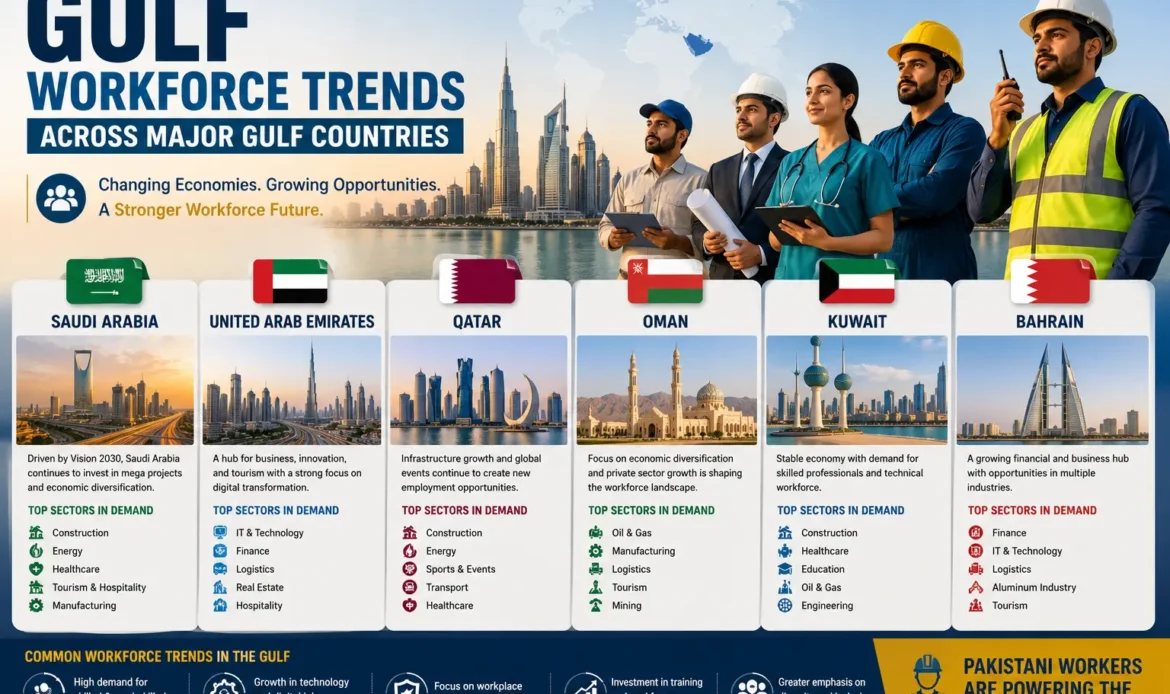
The overall Gulf Workforce Trends are similar in some areas, but every Gulf country has its own employment environment, industries, regulations, and workforce requirements.
Saudi Arabia Workforce Trends
Saudi Arabia Workforce Trends are influenced by infrastructure development, construction, industrial activity, hospitality, technology, energy, and other sectors.
Potential employment areas for Pakistani workers include:
- Construction
- Engineering
- Manufacturing
- Energy
- Healthcare
- Hospitality
- Logistics
- Maintenance
- Technical services
Saudi Jobs for Pakistani Workers can range from skilled trades to professional positions.
Candidates should review each vacancy individually rather than assuming that demand is the same across every occupation.
UAE Workforce Trends
UAE Workforce Trends reflect the country’s diverse economy, including construction, tourism, hospitality, logistics, technology, real estate, healthcare, manufacturing, and facility management.
UAE Jobs for Pakistani Workers may include:
- Engineers
- Technicians
- Construction workers
- Electricians
- HVAC technicians
- IT professionals
- Hospitality employees
- Logistics workers
- Healthcare professionals
- Facility management staff
Workers with technical expertise combined with communication and teamwork skills may be better prepared for competitive positions.
Qatar Workforce Trends
Qatar Workforce Trends can create opportunities across infrastructure, construction, hospitality, energy-related activities, facility management, and services.
Qatar Jobs for Pakistani Workers may be available when employer requirements match a candidate’s qualifications and experience.
Candidates should focus on:
- Technical expertise
- Safety awareness
- Practical experience
- Communication
- Relevant certifications
Oman Workforce Trends
Oman Workforce Trends cover construction, manufacturing, logistics, tourism, maintenance, engineering, and technical services.
Workers interested in Oman Jobs for Pakistani Workers should research the requirements of their occupation and verify employment conditions before accepting an offer.
Kuwait Workforce Trends
Kuwait Workforce Trends can include opportunities in construction, maintenance, engineering, healthcare, hospitality, transportation, and technical services.
Workers interested in Kuwait Jobs for Pakistani Workers should prepare a professional CV that clearly explains their qualifications, technical abilities, experience, and certifications.
Bahrain Workforce Trends
Bahrain Workforce Trends can create opportunities in services, construction, hospitality, manufacturing, logistics, engineering, and other industries.
Candidates considering Bahrain Jobs for Pakistani Workers should match their skills with genuine employer requirements and carefully review employment contracts.
GCC Workforce Trends and Technical Talent
The broader GCC Workforce Trends demonstrate the importance of technical and specialized talent for companies operating across the Gulf.
Businesses may need workers who can:
- Operate equipment
- Maintain systems
- Complete construction tasks
- Manage technical operations
- Follow safety procedures
- Solve workplace problems
- Work with modern technology
- Communicate effectively
This makes technical education and vocational training particularly important for Pakistani workers seeking international employment.
The relationship between technical education and Gulf Workforce Trends is especially relevant for candidates interested in construction, engineering, manufacturing, maintenance, and technical services.
Pakistani Manpower for Gulf Countries
The demand for Pakistani Manpower for Gulf Countries can include both skilled and professional workers.
Depending on employer requirements, recruitment may involve:
Construction
- Masons
- Carpenters
- Steel fixers
- Electricians
- Plumbers
- Welders
- Equipment operators
Engineering
- Civil engineers
- Mechanical engineers
- Electrical engineers
- Site engineers
- Project supervisors
Maintenance
- HVAC technicians
- Mechanical technicians
- Electrical technicians
- Maintenance supervisors
Hospitality
- Chefs
- Waiters
- Housekeeping staff
- Front-office employees
- Supervisors
Healthcare
- Nurses
- Medical technicians
- Healthcare support staff
- Other qualified professionals
These categories demonstrate how Gulf Workforce Trends can create opportunities for workers with different professional and technical backgrounds.
Future Skills for Gulf Jobs
Workers should consider not only today’s vacancies but also the Future Skills for Gulf Jobs that may become increasingly useful.
Technology is changing how companies operate, and workers who continuously improve their capabilities can be better prepared for future employment.
Useful future-oriented skills include:
- Digital literacy
- Data analysis
- Automation awareness
- Computer skills
- Technical software
- Digital communication
- Equipment technology
- Problem-solving
- Continuous learning
Understanding these developments is an important part of responding to changing Gulf Workforce Trends.
A traditional technician does not necessarily need to become a technology specialist. However, understanding the digital tools used in their profession can improve workplace efficiency.
Professional Skills for Gulf Jobs
Technical skills are important, but employers may also evaluate Professional Skills for Gulf Jobs.
These include:
- Communication
- Teamwork
- Leadership
- Time management
- Problem-solving
- Adaptability
- Responsibility
- Workplace discipline
- Professional behavior
For example, an experienced technician who can communicate clearly and cooperate with a multicultural team may provide more value than a technically skilled worker who struggles with teamwork.
Professional development should therefore remain part of every worker’s preparation for the changing Gulf Workforce Trends.
Communication Skills in Gulf Employment
The Gulf workplace is highly multicultural, with employees from different countries often working on the same project.
Communication skills help Pakistani workers:
- Understand instructions
- Report technical problems
- Communicate with supervisors
- Work with colleagues
- Understand safety requirements
- Deal with customers
- Complete workplace documentation
English can be particularly useful in many professional environments, although specific language requirements depend on the employer and occupation.
Strong communication can also help workers adapt to the multicultural environments highlighted by current Gulf Workforce Trends.
Workplace Safety Skills for Gulf Jobs
Safety should be considered one of the essential Skills Required for Gulf Jobs, particularly in construction, manufacturing, engineering, energy, and industrial environments.
Workers should understand:
- Personal protective equipment
- Hazard identification
- Safe equipment operation
- Emergency procedures
- Workplace safety rules
- Incident reporting
- Basic risk awareness
Candidates with relevant safety training should mention it clearly on their CV where appropriate.
Safety awareness is particularly important when employers are recruiting workers for technical and industrial positions.
Digital Skills and Gulf Workforce Trends
Digital transformation is another important element of Gulf Workforce Trends.
Even traditional workers may encounter:
- Digital attendance systems
- Electronic documentation
- Mobile workforce applications
- Digital maintenance systems
- Computerized machinery
- Online reporting
- Technical software
Digital literacy is therefore becoming a useful addition to traditional technical expertise.
Workers who combine trade skills with basic digital abilities can be better prepared for changing workplace requirements.
Gulf Workforce Demand for Skilled Manpower
Gulf Workforce Demand can change according to projects, economic conditions, employer requirements, and individual industries.
For example, a large construction project could require hundreds of skilled and semi-skilled workers, while an engineering company may need a smaller number of highly specialized professionals.
This means workers should focus on developing genuine expertise rather than relying only on general claims about job demand.
Monitoring Gulf Workforce Trends can help candidates understand which industries and skills may be relevant to their career goals.
Gulf Recruitment from Pakistan
Gulf Recruitment from Pakistan involves connecting Pakistani candidates with employers seeking suitable international manpower.
A structured recruitment process may include:
- Candidate registration
- CV screening
- Qualification verification
- Skill assessment
- Employer interviews
- Candidate selection
- Medical procedures
- Documentation
- Visa-related processing
- Deployment
Candidates should use legitimate recruitment channels and verify the terms of every job before proceeding.
Gulf Manpower Recruitment
Gulf Manpower Recruitment can help employers source workers according to project requirements.
For example, an employer may require:
- Electricians
- Welders
- HVAC technicians
- Mechanical technicians
- Engineers
- Construction workers
A professional recruitment process can help identify candidates according to occupation, experience, qualifications, and employer requirements.
Manpower Recruitment from Pakistan
Manpower Recruitment from Pakistan can provide international employers with access to professionals and skilled workers across different industries.
Recruitment agencies may support employers by:
- Sourcing candidates
- Screening applications
- Conducting interviews
- Organizing trade tests
- Verifying documents
- Coordinating recruitment stages
- Supporting deployment processes
The exact services differ according to the recruitment agency and employer agreement.
Pakistani Manpower Recruitment for Gulf Employers
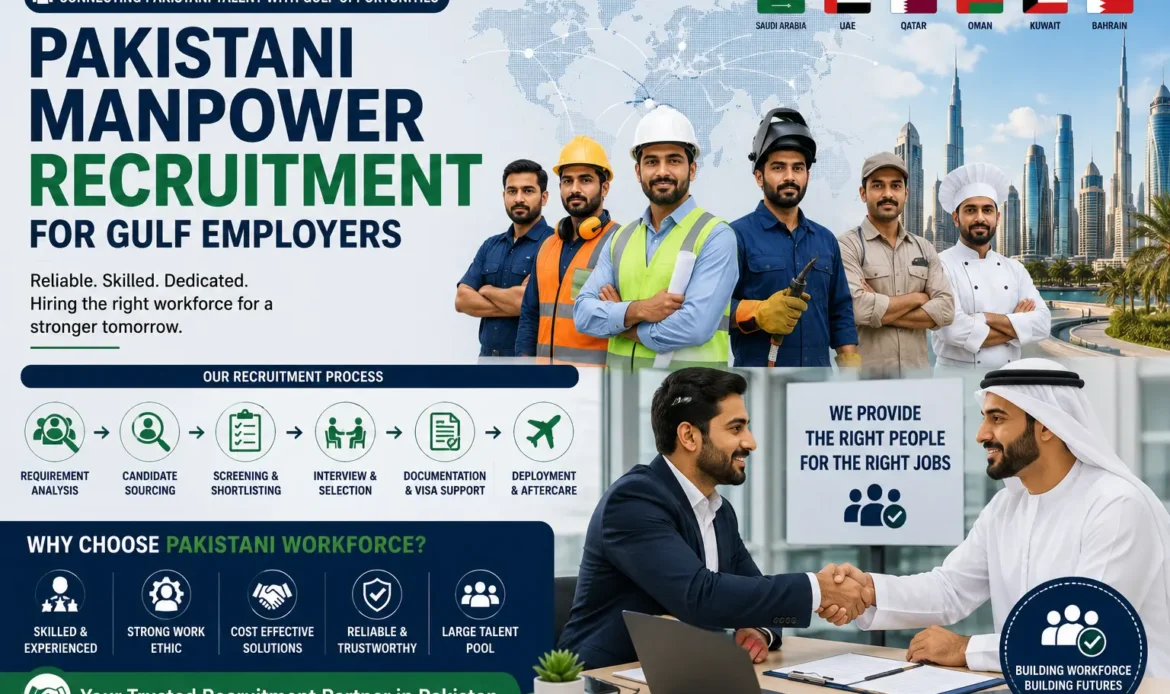
Pakistani Manpower Recruitment can be useful for Gulf employers that require workers for construction, engineering, manufacturing, hospitality, healthcare, logistics, maintenance, and other sectors.
Employers should clearly define:
- Job title
- Number of workers required
- Required experience
- Qualifications
- Technical skills
- Salary
- Working hours
- Benefits
- Contract duration
- Accommodation
- Other employment conditions
Clear requirements allow recruiters to identify candidates who more closely match the vacancy.
Gulf Recruitment Agency in Pakistan
A Gulf Recruitment Agency in Pakistan can assist employers and candidates during different stages of overseas recruitment.
For Pakistani workers, an agency may provide access to vacancies and help organize recruitment procedures.
For employers, an agency may provide access to candidates with relevant qualifications and experience.
Candidates should verify an agency’s licensing, employer information, job offer, and recruitment procedures before making financial or contractual commitments.
Overseas Recruitment Agency in Pakistan
An Overseas Recruitment Agency in Pakistan can serve as a bridge between Pakistani workers and international employers.
Professional recruitment support may involve:
- Candidate sourcing
- Screening
- Interviews
- Skill testing
- Documentation
- Employer coordination
- Deployment support
Workers should confirm that the job opportunity is genuine and understand all applicable costs and contractual terms before proceeding.
How Pakistani Workers Can Prepare for Gulf Jobs in 2026
Understanding Gulf Workforce Trends is useful, but workers also need a practical preparation strategy.
Step 1: Identify Your Profession
Choose an occupation that matches your education, skills, experience, and career objectives.
Step 2: Research Target Countries
Compare the requirements of Saudi Arabia, UAE, Qatar, Oman, Kuwait, and Bahrain.
Step 3: Develop Relevant Skills
Improve technical and professional abilities required for your target occupation.
Step 4: Gain Practical Experience
Hands-on experience can strengthen your CV and improve your ability to perform technical responsibilities.
Step 5: Obtain Relevant Certifications
Where applicable, obtain recognized technical, professional, or safety certifications.
Step 6: Improve Communication
Develop English and workplace communication skills.
Step 7: Prepare a Professional CV
Clearly list your education, experience, technical skills, certifications, and previous international exposure.
Step 8: Verify Recruitment Channels
Use legitimate recruitment channels and verify employers and job offers before proceeding.
How Employers Can Find Skilled Pakistani Workers
Gulf employers looking for workers from Pakistan should create detailed workforce requirements before starting recruitment.
The process can include:
Define the Job
Clearly specify the position, responsibilities, salary, experience, and qualifications.
Identify Required Skills
List the technical and professional skills required for the position.
Screen Candidates
Review CVs and employment histories.
Conduct Skill Testing
Trade tests can help evaluate practical abilities for technical positions.
Interview Candidates
Interviews can assess communication, experience, attitude, and professional suitability.
Verify Documentation
Educational, professional, and employment documents should be checked according to applicable procedures.
This structured approach can help employers respond to changing Gulf Workforce Trends while maintaining a skills-based recruitment process.
How Gulf Employers Benefit from Pakistani Skilled Manpower
International employers may consider Pakistani workers because Pakistan provides a diverse pool of professionals and skilled tradespeople.
Potential advantages include:
- Access to specialized skills
- Large candidate pool
- Experience across different industries
- Availability of technical workers
- Multicultural workforce experience
- Potential for project-based recruitment
However, employers should always select workers according to qualifications, experience, skills, and suitability rather than nationality alone.
24 Seven Recruitment and Gulf Manpower Recruitment
24 Seven Recruitment operates in the international recruitment and manpower sector and can be relevant to employers and Pakistani candidates seeking overseas employment opportunities.
For companies interested in Gulf Recruitment from Pakistan, professional recruitment services can support candidate sourcing, screening, interviews, skill assessment, and other recruitment stages.
24 Seven Recruitment Pakistan can also be relevant to Pakistani workers looking for international employment opportunities where their qualifications and experience match available vacancies.
For employers seeking 24 Seven Manpower Recruitment, clearly defining workforce requirements is important so suitable candidates can be identified.
Candidates should independently verify every job offer, employer, contract, visa process, and applicable recruitment requirement before accepting employment.
Common Mistakes Pakistani Workers Should Avoid
Understanding Gulf Workforce Trends is only one part of successful overseas employment.
Candidates should avoid:
Applying Without Required Skills
Do not apply for jobs where you lack the required qualifications or experience.
Using an Unverified Recruitment Channel
Always verify the recruitment agency and employer.
Providing False Information
Never exaggerate your experience, qualifications, or certifications.
Ignoring Safety Training
Safety knowledge is important for many Gulf occupations.
Accepting an Unclear Contract
Review salary, working hours, accommodation, benefits, contract duration, and other terms carefully.
Relying Only on Salary
Candidates should also consider working conditions, accommodation, location, benefits, and contract terms.
Frequently Asked Questions
What are the major Gulf Workforce Trends in 2026?
The major Gulf Workforce Trends include continued importance of specialized skills, technical workers, professional talent, digital capabilities, workplace safety, practical experience, and adaptable employees. Demand varies according to country, industry, project, and employer.
Which skills are in demand in Gulf countries?
Skills in Demand in Gulf Countries can include engineering, construction trades, electrical work, mechanical maintenance, welding, HVAC, healthcare, IT, logistics, hospitality, and facility management.
Are Pakistani workers in demand in Gulf countries?
Demand varies by employer, industry, project, and country. Qualified Skilled Pakistani Workers can compete for relevant positions when their qualifications and experience match employer requirements.
Which Gulf countries hire Pakistani workers?
Saudi Arabia, UAE, Qatar, Oman, Kuwait, and Bahrain all have employment markets where Pakistani workers may find opportunities, subject to current employer demand and applicable requirements.
What skills are required for Gulf jobs?
The Skills Required for Gulf Jobs depend on the occupation. Technical expertise, practical experience, communication, workplace safety, teamwork, adaptability, and digital literacy can be useful across many sectors.
How can Pakistani workers prepare for Gulf employment?
Workers should develop relevant technical skills, gain practical experience, obtain appropriate certifications, improve communication, prepare a professional CV, and use verified recruitment channels.
Why is technical training important?
Technical training can help workers demonstrate competency and prepare for occupations where employers require specific practical abilities.
Conclusion:
The latest Gulf Workforce Trends demonstrate the importance of skills, experience, adaptability, digital awareness, safety knowledge, and professional preparation in the international employment market.
For Pakistani candidates, opportunities can exist across construction, engineering, manufacturing, healthcare, hospitality, logistics, maintenance, technology, and other industries. However, candidates should focus on developing the specific capabilities required by their target occupation.
The strongest candidates are not necessarily those who apply to the largest number of vacancies. They are candidates who understand employer requirements, develop relevant skills, maintain accurate documentation, communicate professionally, and use legitimate recruitment channels.
For employers, Pakistani Manpower for Gulf Countries can provide access to professionals, technicians, and skilled workers across multiple industries. A structured recruitment process involving skill assessment, candidate screening, interviews, and document verification can help employers identify suitable talent.
As Gulf Hiring Trends 2026 continue to evolve, Pakistani workers who invest in technical expertise, digital capabilities, communication, safety awareness, and continuous learning can position themselves for stronger international career opportunities.
For candidates and employers exploring overseas recruitment, 24 Seven Recruitment and other professional recruitment services can be considered as part of a broader, verified recruitment strategy.
The key takeaway is simple: understand the Gulf Workforce Trends, develop the right skills, verify recruitment channels, and target jobs that genuinely match your experience and qualifications.