




























































Finding a job abroad can be an important career opportunity for Pakistani professionals, skilled workers, technicians, and experienced candidates. However, getting an international job involves much more than receiving a job offer. Workers need to understand recruitment requirements, document preparation, interviews, medical examinations, visa procedures, registration, and pre-departure formalities.
The Overseas Employment Process provides a structured path for Pakistani workers who want to legally work in another country. Following the correct steps can help candidates avoid unnecessary delays, understand their employment contracts, and make more informed decisions before travelling.
The Overseas Employment Process in Pakistan may vary depending on the destination country, occupation, employer, and recruitment method. A construction worker may have different requirements from an engineer, nurse, IT professional, driver, electrician, or mechanical technician.
For first-time workers, understanding the complete process can make overseas job applications easier and more organized. This guide explains the major stages, documents, recruitment methods, visa requirements, common mistakes, and preparation tips for Pakistani workers in 2026.
What Is the Overseas Employment Process?
The Overseas Employment Process refers to the complete series of steps a Pakistani worker follows to secure legal employment in a foreign country.
Although the exact requirements differ by destination, the general process normally includes:
- Finding a suitable overseas vacancy
- Checking job eligibility
- Preparing a professional CV
- Collecting supporting documents
- Registering through an appropriate recruitment channel
- Submitting a job application
- Completing candidate screening
- Attending an employer interview
- Completing a skills or trade test when required
- Receiving a job offer
- Reviewing the employment contract
- Completing document verification
- Undergoing the required medical examination
- Obtaining a work visa or permit
- Completing required worker registration
- Preparing for departure
- Travelling to the destination country
- Completing joining formalities
Understanding these stages gives first-time applicants a clear roadmap and helps them prepare for each stage instead of making decisions at the last minute.
Step 1: Find the Right Overseas Job
The first stage of the Overseas Employment Process is finding a vacancy that matches your qualifications, experience, and professional skills.
Pakistani candidates can explore overseas jobs from Pakistan in a wide range of industries, including:
- Construction
- Engineering
- Healthcare
- Information technology
- Manufacturing
- Hospitality
- Logistics
- Transportation
- Oil and gas
- Facility management
- Electrical trades
- Mechanical trades
- Technical services
Candidates should avoid applying for jobs simply because they offer an attractive salary.
Instead, consider whether your education, experience, certifications, and practical skills match the employer’s requirements.
For example, an experienced electrician may search for electrical technician, industrial electrician, maintenance electrician, or electrical supervisor positions. A welder can target welding and fabrication vacancies, while an HVAC technician can look for air-conditioning and refrigeration maintenance roles.
Choosing a position that matches your professional background can improve your chances of selection and support long-term career development.
Step 2: Check Overseas Employment Requirements
Before applying for any vacancy, carefully review the eligibility criteria.
Common overseas employment requirements may include:
- Relevant educational qualifications
- Technical certifications
- Previous work experience
- Professional licenses
- Technical skills
- Language proficiency
- Valid passport
- Age requirements where applicable
- Medical fitness
- Skills or trade testing
Requirements can differ significantly between countries and professions.
For example, healthcare professionals may need professional registration or licensing before they can legally work. Skilled tradespeople may need to complete a practical assessment to demonstrate their abilities.
Checking these requirements before submitting an application can help candidates avoid applying for unsuitable positions.
Step 3: Prepare a Professional CV
A professional CV is one of the most important documents in the overseas job application process.
Your CV should clearly explain your professional background and demonstrate why you are suitable for the position.
Include:
- Professional title
- Years of experience
- Previous employers
- Job responsibilities
- Educational qualifications
- Technical skills
- Professional certifications
- Major achievements
- Language skills
- Previous international experience
Keep the CV concise, accurate, and relevant to the vacancy.
For technical positions, clearly mention the equipment, tools, systems, machinery, or technologies you have experience using.
If you have previous experience in Saudi Arabia, the UAE, Qatar, Oman, Kuwait, Bahrain, Europe, or another international market, include the relevant details where appropriate.
Step 4: Organize Your Employment Documents
Document preparation is another important part of the Overseas Employment Process.
Depending on the destination and position, workers may need documents such as:
- Valid passport
- CNIC or identification document
- Educational certificates
- Experience certificates
- Professional certifications
- Skills certificates
- Passport-size photographs
- Medical documents
- Police clearance where required
- Employment contract
- Work permit
- Visa documents
Organize your overseas employment documentation before applying whenever possible.
Make sure your name, date of birth, qualifications, and other personal information are consistent across important documents.
Incorrect or inconsistent information can result in delays during recruitment or visa processing.
Step 5: Choose a Reliable Recruitment Channel
After preparing your documents, identify a reliable method for finding and applying for international employment.
Candidates may find vacancies through:
- Direct employers
- Official job portals
- Government-supported employment channels
- Licensed recruitment agencies
- Employer recruitment campaigns
- Professional networks
If you choose an overseas recruitment agency in Pakistan, verify its credentials and understand the recruitment procedure before submitting your documents.
A professional recruitment provider should clearly explain the vacancy, employer, job requirements, salary, employment conditions, and recruitment stages.
Avoid sources that provide vague information about the employer or promise guaranteed employment without proper selection.
Step 6: Complete the Overseas Recruitment Process
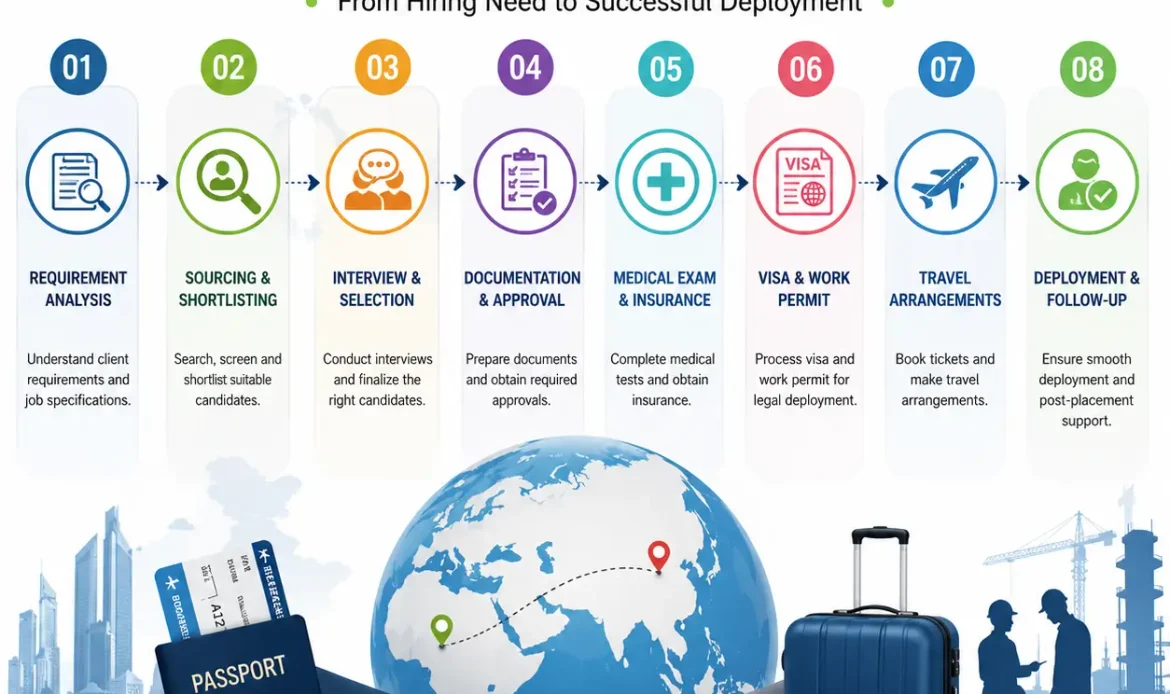
The overseas recruitment process normally begins after a candidate submits an application for a suitable vacancy.
The recruitment team may review:
- Educational qualifications
- Work experience
- Technical skills
- Certifications
- Previous employment
- Language abilities
- Age
- Job-specific eligibility
Candidates whose profiles match the employer’s requirements may be shortlisted for an interview or practical assessment.
Recruitment processes can differ from one employer to another, so candidates should follow the specific instructions provided for their vacancy.
Step 7: Attend the Employer Interview
An employer interview is an important stage for many overseas jobs for Pakistani workers.
Interviews can be conducted:
- Online
- In person
- At a recruitment center
- During an employer visit
- Through a designated recruitment event
Before attending, review the job description and prepare examples from your previous work experience.
Employers may ask questions about:
- Previous jobs
- Technical knowledge
- Professional responsibilities
- Workplace safety
- Equipment and tools
- Previous projects
- Availability
- Relocation
- Salary expectations
For skilled trades, the employer may also ask practical questions to determine whether the candidate understands the job requirements.
Step 8: Complete Skills or Trade Testing
Some employers require candidates to complete a practical skills assessment.
This can be particularly common for technical and skilled positions such as:
- Electricians
- Welders
- Plumbers
- HVAC technicians
- Mechanics
- Machine operators
- Fabricators
- Construction workers
- Maintenance technicians
The purpose of a trade test is to evaluate whether a worker can perform the practical duties required for the position.
Candidates should always provide truthful information about their skills and experience.
Do not accept a position that requires technical abilities you do not possess simply because the salary appears attractive.
Step 9: Receive and Review the Job Offer
If the employer selects you, you may receive an employment offer or contract.
This is an important stage of the Overseas Employment Process because the written offer should explain the key terms of your employment.
Check:
- Job title
- Basic salary
- Overtime
- Working hours
- Contract duration
- Accommodation
- Transportation
- Medical benefits
- Annual leave
- Air ticket arrangements
- Probation period
- Employer details
- Visa arrangements
Never rely only on verbal promises.
If the employer or recruiter promises a particular salary, benefit, accommodation arrangement, or working condition, make sure the agreed terms are properly documented.
Step 10: Understand Your Employment Contract
Before signing the contract, carefully read every important section.
Salary and Allowances
Confirm your basic salary and determine whether food, housing, transportation, or other allowances are included.
Working Hours
Understand normal working hours, weekly rest days, overtime, and shift arrangements.
Accommodation
Find out whether the employer provides accommodation or whether you are responsible for your own housing.
Transportation
Check whether transportation between accommodation and the workplace is included.
Medical Benefits
Review the employer’s medical insurance or healthcare arrangements.
Contract Duration
Understand the contract length, renewal conditions, probation period, and termination provisions.
Leave Entitlement
Check annual leave, public holidays, sick leave, and other applicable leave conditions.
If any section is unclear, ask questions before signing.
Step 11: Complete Medical Requirements
Medical examination may be an important requirement for international employment.
The exact medical requirements depend on the destination country, job category, and visa type.
Workers may need to complete health checks through an approved medical facility.
Candidates should follow the requirements communicated by the relevant authorities, employer, or authorized recruitment provider.
A medical examination is only one part of the overall process. Completing it does not necessarily mean that every other employment or immigration requirement has been completed.
Step 12: Apply for the Work Visa
Obtaining the appropriate employment authorization is one of the most important stages of international recruitment.
The work visa for Pakistani workers depends on the destination country, employer, and type of employment.
The application may require:
- Valid passport
- Employment contract
- Employer sponsorship
- Work permit
- Medical documents
- Police clearance where required
- Educational certificates
- Professional certifications
- Visa application forms
- Additional immigration documents
Always follow the current requirements applicable to your destination.
Do not travel for employment without confirming that you have the appropriate legal authorization to work.
A tourist or visit visa should not be treated as a substitute for the required employment visa or work permit.
Step 13: Complete Overseas Worker Registration
Depending on the recruitment route and destination, Pakistani workers may need to complete relevant registration and pre-departure formalities.
Overseas worker registration can be an important part of preparing for legal employment abroad.
First-time applicants should confirm the latest requirements through appropriate official sources or their authorized recruitment provider.
Do not assume that the same procedure applies to every country. Requirements can differ based on destination, occupation, employer, and recruitment route.
Step 14: Complete Pre-Departure Preparation
Once the major recruitment and visa requirements are completed, workers should prepare for their journey.
Keep the following documents accessible:
- Passport
- Work visa or permit
- Employment contract
- Educational certificates
- Experience letters
- Professional certifications
- Medical documents
- Employer contact details
- Accommodation information
- Emergency contacts
- Copies of important documents
Keep secure digital copies as well as physical copies.
It is also useful to learn about the destination country’s basic laws, workplace culture, transportation, climate, and living environment.
Step 15: Travel and Join Your Employer
After completing the required formalities, the worker can travel according to the approved employment arrangements.
After arrival, additional procedures may be required, such as:
- Residence documentation
- Local registration
- Employee onboarding
- Workplace orientation
- Safety training
- Local medical procedures
- Biometric procedures where applicable
Follow the instructions provided by the employer and comply with local employment laws.
Popular Overseas Employment Destinations for Pakistani Workers
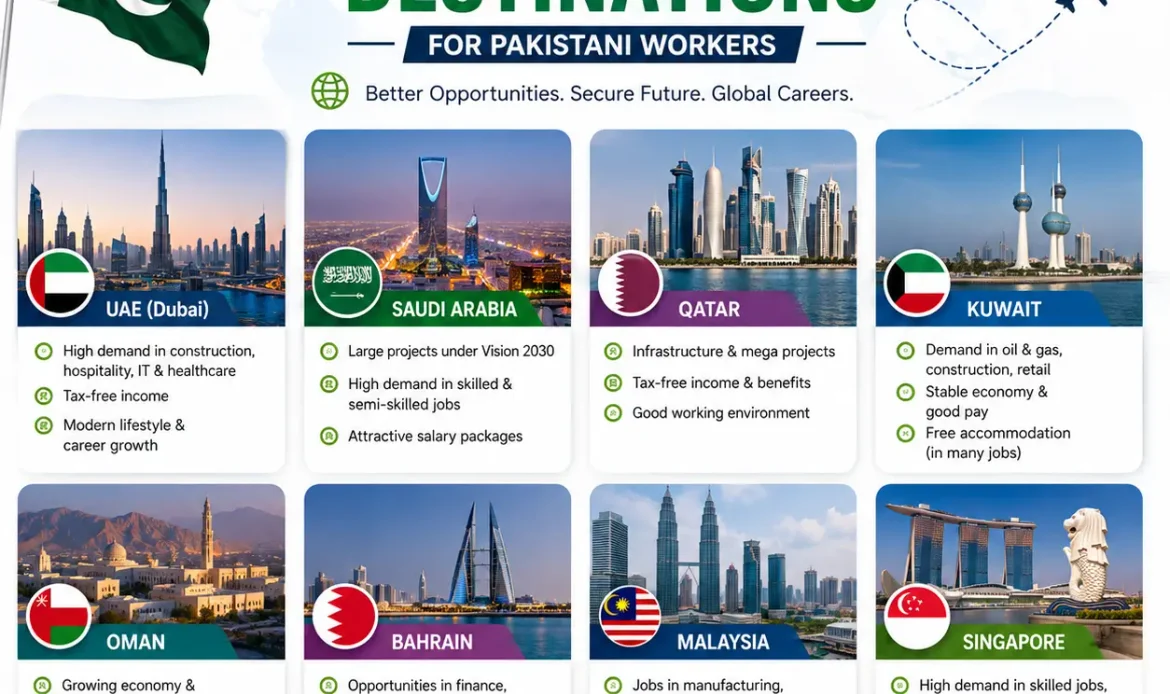
Pakistani workers can explore overseas employment opportunities in different regions depending on their profession and qualifications.
Gulf Countries
Gulf countries remain important destinations for Pakistani workers.
Major markets include:
- Saudi Arabia
- United Arab Emirates
- Qatar
- Oman
- Kuwait
- Bahrain
Potential sectors include:
- Construction
- Engineering
- Healthcare
- Hospitality
- Manufacturing
- Logistics
- Transportation
- Oil and gas
- Facility management
- Technical trades
The suitability of each country depends on the worker’s profession, employer, salary expectations, and employment conditions.
European Countries
European countries can provide opportunities for skilled professionals and technical workers.
Potential sectors include:
- Manufacturing
- Construction
- Engineering
- Healthcare
- Automotive
- Logistics
- Information technology
- Skilled trades
However, European employment may involve qualification recognition, language requirements, professional licensing, and specific work permit procedures.
Candidates should research the individual country’s requirements rather than assuming that one process applies across all European destinations.
Documents Checklist for Overseas Workers
Preparing documents early can make the Overseas Employment Process more organized.
A general checklist may include:
| Document | Purpose |
|---|---|
| Passport | International identification and travel |
| CNIC | Pakistani identification |
| Educational certificates | Qualification verification |
| Experience certificates | Employment history |
| Professional certifications | Skills verification |
| Medical documents | Health requirements |
| Police clearance | Where required |
| Employment contract | Job terms |
| Work permit | Legal employment authorization |
| Visa | Permission to enter/work according to visa terms |
| Photographs | Application requirements |
The exact document list can vary by country and profession.
How Much Does Overseas Employment Cost?
The cost of finding employment abroad depends on several factors.
Potential expenses may include:
- Passport-related costs
- Document preparation
- Attestation or verification where required
- Medical examination
- Skills testing
- Visa-related costs
- Travel expenses
- Recruitment-related charges where legally applicable
- Pre-departure requirements
Candidates should always request clear information about any applicable charges.
Be cautious if someone demands a large payment without providing documentation, a clear job offer, or information about the employer.
Do not assume that paying a fee guarantees employment.
How to Identify a Genuine Overseas Job
Finding genuine jobs abroad from Pakistan requires careful verification.
Before accepting an offer, check:
- Employer identity
- Job title
- Employment contract
- Salary
- Working hours
- Benefits
- Accommodation
- Transportation
- Visa arrangements
- Recruitment channel
Be especially careful with offers that:
- Promise unusually high salaries
- Require payment before providing basic job information
- Refuse to identify the employer
- Request unnecessary personal information
- Offer employment without an interview
- Guarantee a visa without proper documentation
If an offer seems too good to be true, verify it carefully before proceeding.
Common Mistakes First-Time Workers Should Avoid
The Overseas Employment Process can become difficult when applicants make avoidable mistakes.
Choosing a Job Only Because of Salary
A high salary does not necessarily mean higher savings. Consider accommodation, transportation, food, taxes where applicable, and other living expenses.
Accepting Verbal Promises
Important employment conditions should be clearly documented.
Ignoring Visa Requirements
Do not travel without the correct authorization to work.
Applying for Jobs Without Checking Qualifications
Make sure your education, experience, skills, and certifications match the vacancy.
Using an Unverified Recruitment Source
Verify the recruitment provider and employer before sharing documents or making payments.
Providing False Information
False qualifications or exaggerated experience can result in rejection or employment problems.
Failing to Prepare Documents
Missing certificates or inconsistent information can delay recruitment.
How to Make the Overseas Employment Process Easier
First-time applicants can take several practical steps to make the Overseas Employment Process more organized.
Start Preparing Before Applying
Collect your passport, certificates, experience letters, CV, and other important documents early.
Research the Destination
Learn about employment rules, living costs, language requirements, workplace conditions, and visa procedures.
Apply for Suitable Positions
Focus on vacancies that match your qualifications and experience.
Keep Your CV Updated
Make sure your CV reflects your latest professional experience and technical skills.
Verify Every Important Detail
Confirm the employer, job title, salary, contract, accommodation, benefits, and visa arrangements.
Keep Copies of Your Documents
Store secure digital copies of important paperwork.
Ask Questions
If you do not understand a recruitment requirement or contract term, request clarification before proceeding.
Benefits of Following a Proper Recruitment Process
Following the correct recruitment steps can help Pakistani workers:
- Find jobs that match their skills
- Prepare documents correctly
- Understand employer expectations
- Improve interview preparation
- Complete skills assessments
- Review contracts carefully
- Reduce recruitment risks
- Prepare for relocation
- Start employment with better awareness
A structured approach is particularly valuable for first-time applicants who have never worked outside Pakistan.
Final Checklist Before Travelling Abroad
Before departure, make sure you have completed the major stages of the Overseas Employment Process.
Job and Employer
- Job offer verified
- Employer information confirmed
- Job title understood
- Salary confirmed
- Benefits reviewed
- Contract signed
Documents
- Passport valid
- Educational certificates prepared
- Experience certificates available
- Professional certifications ready
- Medical requirements completed
- Required police clearance obtained where applicable
Visa and Registration
- Appropriate work visa confirmed
- Work permit confirmed where applicable
- Required worker registration completed
- Pre-departure requirements completed
Travel
- Flight arrangements confirmed
- Accommodation information available
- Employer contact saved
- Emergency contacts available
- Digital copies of important documents stored
Completing this checklist can help reduce confusion before departure.
Frequently Asked Questions
What is the Overseas Employment Process?
The Overseas Employment Process is the series of steps required to obtain legal employment abroad, including job selection, recruitment, interviews, documentation, medical requirements, visa processing, registration, and departure preparation.
Can Pakistani workers apply for overseas jobs directly?
Yes, depending on the vacancy, candidates may apply directly to international employers or use appropriate job portals and recruitment channels.
What documents are commonly required?
Common documents can include a valid passport, educational certificates, experience letters, professional certifications, medical documents, employment contracts, and visa-related paperwork.
Is a medical examination always required?
Medical requirements depend on the destination country, employment category, and visa type.
Can I travel on a visit visa for an overseas job?
Workers should obtain the appropriate legal authorization required for employment rather than relying on a visit visa.
Should I use a recruitment agency?
A recruitment agency can be useful when it is properly authorized and transparent about the employer, vacancy, recruitment process, and applicable requirements. Always verify credentials before proceeding.
Final Thoughts
The Overseas Employment Process is an important journey for Pakistani professionals, skilled workers, technicians, and other candidates who want to build careers abroad. From finding suitable overseas jobs from Pakistan to completing recruitment, interviews, documentation, medical requirements, visa processing, registration, and departure preparation, every stage deserves careful attention.
The best approach is to choose a job that matches your qualifications and experience, verify the employer, understand the employment contract, prepare your documents, and follow the appropriate visa and employment procedures.
Whether you are searching for construction jobs, engineering positions, healthcare employment, IT opportunities, manufacturing work, logistics roles, or skilled technical jobs, proper preparation can help you make better decisions.
For first-time workers, the most important lesson is simple: do not rush the recruitment process. Verify important information, ask questions when something is unclear, and use reliable recruitment channels.
With proper planning and accurate documentation, Pakistani workers can approach international employment opportunities with greater confidence and take informed steps toward building a successful career abroad in 2026.